May 8, 2018

BINGIN' ON BRONSON

https://www.millcreekent.com/
THE VALACHI PAPERS - Starring Charles Bronson, Lino Ventura, Jill Ireland. Directed by Terence Young.
THE STONE KILLER - Starring Charles Bronson, Martin Balsam, David Sheiner, Norman Fell, Stuart Margolin, Paul Koslo, Ralph Waite. Directed by Michael Winner.
BREAKOUT - Starring Charles Bronson, Jill Ireland, Robert Duvall, Randy Quaid, John Huston. Directed by Tom Gries.
HARD TIMES - Starring Charles Bronson, James Coburn, Jill Ireland, Strother Martin. Directed by Walter Hill.  
(1972-1975/409 min).

AVAILABLE ON BLU-RAY & DVD FROM

Review by Tiger Longtail😼

As a child of the 70s, I can't think of many better ways to spend a Saturday night than binging on some Classic Bronson, which is not the same as watching Charles Bronson classics (only Death Wish might arguably qualify as both).

"Charles Bronson classics" are those unquestionably iconic films we all love, like The Great Escape, The Magnificent Seven, Once Upon a Time in the West, and The Dirty Dozen, just to name a few. Great films all, and Chuck is wonderful in them, though their greatness isn't necessarily because of him. "Classic Bronson," on the other hand, are those flicks he did in the 1970s. His tough guy image well-established, Chuck could be counted on to crank out a few action-oriented potboilers every year. Death Wish notwithstanding, few of them were blockbusters or critical darlings, but were usually profitable, economically made and didn't require Bronson to stretch much as an actor.

Most importantly, they were a lot of undemanding fun. This was the Charles Bronson I grew up on, the Liam Neeson of my generation. Hence, this four film collection doesn't contain any classics, but it's chock-full of Classic Bronson. And unlike other Bronson collections - like the crap he coughed-up with Cannon Films in the 80s - there ain't a single pooch in the package.

Chuck learns where babies come from.
The 1972 mob movie, The Valachi Papers, came out the same year as The Godfather, but the similarities pretty much end there. Based on a true story, Bronson plays the titular character, a lifelong mafioso who turns state's evidence after he learns his don has put a contract out on him. Valachi's life is chronicled through flashbacks, and while the film in nowhere near as rich or nuanced as The Godfather, what it lacks in artistry it makes up for with violent sensationalism and pulpy action.

In The Stone Killer, Bronson is a hard-ass cop investigating the public murder of a former mob assassin. He's supported by a solid supporting cast, including Martin Balsam as a mafia don who hires a batch of Vietnam veterans to assassinate his current rivals...revenge for a mob hit that occurred in 1931. The plot is sort-of convoluted and some of the dialogue is decidedly un-PC by today's standards, but Chuck gets to shoot people and drive his car through buildings.

On the set, Bronson has been known to 'breakout'...into song.
I remember seeing Breakout in theaters, which was a slight change of pace for Bronson at the time. He's given the chance to lighten up, even be funny on occasion, as Nick Colton, a scruffy freelance pilot. Ann Wagner (real-life wife Jill Ireland, who co-stars in three of the four films in this set) hires Colton to free her husband (Robert Duvall) from a Mexican prison. It's a bit more laid-back and leisurely paced than the usual Bronson vehicle, but the final act is piles-on the action we signed up for, punctuated by a character who's gloriously dispatched by an airplane propeller.

Finally, Hard Times is the one film in the collection that arguably transcends the Classic Bronson tag, and additional proof that director Walter Hill once made good movies. Taking place during the Great Depression, Bronson is a drifter who eeks out a living with his fists (yay!) in illegal bare-knuckle boxing matches. He hooks up with slick huckster "Speed" Weed (James Coburn), whose much better at wheeling and dealing than he is at managing money. More of a character study than an action film, this one features engaging characters, fine performances all-around and authentic attention to period detail.

Watching these old chestnuts certainly takes me back, as they certainly will for a lot of people. They're definitely representative of the era and hardly masterpieces, but prime examples of Classic Bronson. This collection from Mill Creek doesn't include any additional bells & whistles, but it's a binge-worthy batch o' Bronson for your buck.

KITTY CONSENSUS:
PURR-R-R...LIKE A GOOD SCRATCH BEHIND THE EARS

Is PARADOX (2017) a Paradox?

Starring Louis Koo, Lam Ka Tung, Wu Yue, Chris Collins, Tony Jaa. Gordon Lam, Hanna Chan. Directed by Wilson Yip. (2017/98 min).

AVAILABLE ON BLU-RAY FROM
WELL GO USA

Review by Tiger Longtail😼

Paradox is the third film in Wilson Yip's "SPL" franchise. The first two are better known to American audiences as Kill Zone and Kill Zone 2. Not that it really matters because none of them are actually related to each other. Paradox features the return of Wilson Yip (Ip Man) to the director's chair after skipping the previous film.

Louis Koo, Wu Yue and Tony Jaa are also back, but as different characters. This time, Koo plays Lee, a widowed Hong Kong cop whose daughter goes missing when she visits Pattaya. He and the detective assigned to the case, Chui Kit (Wu Yue), suspect she's been abducted. Meanwhile, the mayor has a heart attack and needs a transplant, which is arranged by his assistant, Cheng (Gordon Lam), who enlists the services of Sacha (Chris Collins). Sasha run an organization that sells organs on the black market. And guess whose heart they want.

"Thumbs up, buddy!"     "Back at ya, bro!"
Though thematically similar, Paradox is an all-around much better film than Kill Zone 2, which completely fell apart in the final act. Here, the story grabs the viewer right away and doesn't let go. This film trims the excess fat and breathlessly moves from one action sequence to the next, with a lot of violent gunplay, chases and, of course, close-quarters martial arts, the latter of which features some creatively-ambitious choreography.

Louis Koo decides to dine & dash.
Among the mayhem are interesting characters. It was a smart choice having Louis Koo play the protagonist this time. Always an intense physical actor, Koo also effectively balances the parental sensitivity and protectiveness his character requires while snapping some limbs along the way. Tony Jaa's character feels like a gratuitous shout-out to the last film, but Chui Kit makes a good "partner," whose own family becomes at-risk as they uncover the human traffickers. As for their foes...Paradox gives us some despicable bad guys that we can't wait to see die...as violently as possible (Chris makes Sacha a deliciously hateful bastard).

Paradox goes to some dark places in terms of tone and narrative, but that's also part of what makes it far more engrossing than its predecessors. Since the SPL films are all stand-alone stories anyway, there's no need for the viewer to bring themselves up-to-speed. Paradox is consistently intense, exciting and well-worth checking out by action fans.

EXTRA KIBBLES
4 MAKING OF FEATURETTES
TRAILER
DVD COPY
KITTY CONSENSUS:
PURR-R-R...LIKE A GOOD SCRATCH BEHIND THE EARS

May 5, 2018

THIS IS CINERAMA...and You Should Be Grateful

http://www.flickeralley.com/
Narrated by Lowell Thomas. Directed by Robert L. Bendick. (1952/127 min).

AVAILABLE ON BLU-RAY FROM

Review by Stinky the Destroyer😾

Everyone who loves the visual & sonic eye candy of today's blockbusters probably owes ol' Fred Waller a tip of the hat.

Once upon a time, television was the scourge of Hollywood, threatening the studios' livelyhood by beaming moving images right into people's living rooms...for free. Studios fought back the only way they knew how, with technical advances that tiny black & white boxes simply couldn't reproduce. This was when 3-D and widescreen came into prominence, not-to-mention hucksters like William Castle peddling such glorious gimmicks as "Emergo," "Percepto" and - my favorite - "Coward's Corner."

Then there was Cinerama, a technique developed by Fred Waller that utilized three projectors to present a single image on a super-wide curved screen. Depending on where you were seated, the result was as close to a completely immersive experience as you could get, the picture filling your entire field of vision. Cinerama wasn't without its limitations. The way films were required to be shot was not conducive to close-ups, which generally meant the process lent itself best to documentaries.

However, if it weren't for the visual and audio advances introduced by Cinerama, chances are we wouldn't have eventually gotten CinemaScope, Todd-AO, Panavision, 70mm, Dolby, THX, IMAX or HD, to say nothing of motion simulator theme park rides and massive curved screen TVs. This is Cinerama was the world's first look at this technical milestone.

This is Cinerama re-release one-sheet.
This is Cinerama is not-so-much a movie - or even a documentary - as it is a promotional tool that was used to show people what they were missing by being couch potatoes. And the public responded by making it the highest grossing film of 1952. 

It goes without saying that watching the film at home is an entirely different experience. No matter how big your TV is, This is Cinerama is simply not going to look or sound as impressive as it did on all those super-screens popping up in the 1950s. It helps, of course, if one remains aware of Cinerama's impact at the time. From a historical perspective, this is one of the most important films ever made.

That doesn't always make it interesting. In fact, after the iconic opening scene - a rollercoaster ride from the view of the lead car - the first half is kind-of meandering as it moves from one location to the next - mostly in Europe - capturing operas, bullfights, dancers and a humorously out-of-place performance by the Vienna Boys Choir. But after a brief intermission (this disc retains the film's original roadshow presentation) interest picks up significantly as the film returns to the wonders in its own backyard, such as a water-skiing show in Florida and, most impressively, a coast-to-coast aerial tour of the United States.

Smile!
Aesthetically, This is Cinerama is a bit dated, with some of the human subjects looking like they just stepped out of a Devo album cover. However, even six decades later, some of the imagery remains colorful and visually jaw-dropping. The film has been released on Blu-Ray before. This time, however, it's been restored using the original three-panel negatives, meaning the frame overlaps are clearly visible. But they were always noticeable in every Cinerama film back then, and seeing them here is part of the disc's charm. That, coupled with the "Smilebox" presentation (simulating the old curved screens) and outstanding audio make this disc the closest thing possible to the original theater experience.

Flicker Alley has also included a bunch of informative bonus features that are just as entertaining as the movie itself, maybe even more so for passionate cinephiles.

EXTRA KIBBLES
"THE BEST IN THE BIZ" - This is an hour-long retrosoective dicumentary focusing on many of the composers who score various Cinerama films.
"RESTORING THIS IS CINERAMA" - An extremely detailed summary of how this new restoration was accomplished, narrated by Dave Strohmaier, by one of the guys in charge.
ALTERNATE OPENING TO ACT II OF THE EUROPEAN VERSION - This has not been restored, which helps demonstrate how good the new restoration of the film itself really is.
"CINERAMA EVERYWHERE: French-made short
"CINERAMA! AT THE NEW NEON" - This my favorite extra, a short about a theater in Ohio who began reviving Cinerama movies after a guy named John Harvey built himself a Cinerama projection system in his home.
RADIO INTERVIEW - With Fred Waller
AUDIO COMMENTARY - By John Sittig (of Cinerama Inc), Dave Strohmaier, Randy Gitsch (historian & producer from The Cinerama Restoration Team) and Jim Morrison (an original crew member).
2002 TRAILER - Made for the 50th Anniversary showing at the Cinerama Dome.
"BREAKDOWN REEL" - This film was shown to audiences whenever there were one of the reels broke (featuring Narrator/Co-porducer Lowell Thomas).
TV SPOTS
BOOKLET INSERT - With an essay by Randy Gitsch (Producer from The Cinerama Restoration Team).
KITTY CONSENSUS:
PURR-R-R...LIKE A GOOD SCRATCH BEHIND THE EARS

May 4, 2018

BLACK PANTHER: The Women of Wakanda

https://www.youtube.com/watch?v=KPxrqo82I0s
Available Digitally in HD, 4K Ultra HD™ and Movies Anywhere on May 8 and on 4K Ultra HD™, Blu-ray™, DVD and On-Demand on May 15. 

THE WOMEN OF WAKANDA

PRESS RELEASE: The in-home release of Marvel Studios’ Black Panther is packed with bonus material including deleted scenes, outtakes and never-before-seen featurettes. The highly-celebrated story of a young African prince named T’Challa (played by Chadwick Boseman) has thrilled and inspired generations of moviegoers around the world, and dominated box office charts. Black Panther be

To celebrate the in-home launch of the mighty Marvel movie, we chat to the cast and crew about the women of Wakanda, which is the subject of one of the exclusive bonus features: The Warriors Within. Look no further if you want to get to know Wakanda’s women and the amazing actors who portray them…


LUPITA NYONG’O [NAKIA]
“I love the way Black Panther represents women. Each and every one of us [in the movie] is an individual. We all have our own sense of power and we hold our own space without being pitted against each other. I think that’s a very, very powerful message to send to children – both male and female.

“In Black Panther, we see women going about their business and supporting each other. They argue with each other and have different points of view, but they are not pitted against each other and I think that’s extremely important. In doing this, audiences can get a sense of the fabric of Wakanda as a nation, where we see women alongside men and we see how much more effective a society can be if they allow women to explore their full potential.

“Cinema has the potential to show us who we’ve been, who we are, and who we could be – and Wakanda is an example of who we could be. This is a nation that has been allowed to self-determine because it has avoided the interruption that colonialism was; that assault on a culture and the imposition of a new culture on another. It has figured out how to develop on its own terms. And with that development, it seems they have figured out how to allow their citizens to realize their fullest potential, which means that women can hold their power and not compromise or jeopardize the man’s power. In Wakanda, a woman can assume her own power – but she can also stand with and in support of the man at her side.

“We can see that with the character of Black Panther, who is this all-powerful, vibranium-wearing guy who has Okoye [played by Danai Gurira] by his side. He also has a confidant in my character, Nakia. She’s someone that he can listen to and consider on a level plain. I think that’s really cool to see. I love the way that you get to see it unapologetic and unexplained; it’s just the way it is in a country you’ve never visited before. I feel like this gives you a glimpse as to what is possible in the real world.”

DANAI GURIRA [OKOYE]
“When [Black Panther director and co-writer] Ryan Coogler sat me down and talked to me about his vision for the movie, the story, the characters – and the women – I was floored because you don’t get to hear stories like this very often. It’s not often that you sit down and hear that type of a vision. It was amazing.

“There are so many great things I could say about how Ryan developed the women characters in the movie. I feel really blessed and excited by the fact he allowed us to collaborate, too. I love the fact that these women from the continent are very developed and very complex. I remember thinking, ‘Wow, this is something else. I just want to watch it, but now I also get to be in it.’

“I was immediately drawn to the idea of the Dora Milaje [an all-female, special forces security team]. I loved the concept of them, but it was incredible to see them come to life [during pre-production]. I started to train with all these astounding women and then we all started to get our heads shaved for the movie. I was the first to have it done, but then all the girls started coming in with no hair. One-by-one, we’d all been balded – but we were united together. That’s when our pride started to grow. We all started to embrace this symbol of power in these women.

“I love the moment in the movie where Okoye doesn’t want a wig. She doesn’t want to cover up her head. This is her joy and her pride, so she wants to walk in there with her bald head and that tattoo. I thought that moment was so subversive. It’s so subversive in the right way to say that you don’t have to have hair to be beautiful.”

LETITIA WRIGHT [SHURI]
“I think it’s great to see so many strong women in Black Panther because there’s a lack of them in cinema right now; especially black female characters. All these female characters in the movie are really well rounded, too. They are not just written one way. The women have a lot of complexity. It was really refreshing to see and it’s inspiring to be part of it, because it means a lot to me.

“I also love the way that the men are always behind the women in Wakanda. Nobody is undermined by the other sex. The men don’t stand around and say, ‘Shuri, you shouldn’t be into technology and math.’ They’re like, ‘No, go ahead.’ T’Challa says, ‘Go ahead, Sis. This is your department. This is your domain. Do your thing. Stay in your lane.’ I love that that’s the mentality of the king. It’s brilliant. Everybody’s got their own lane.

“I love what Marvel has done with this movie. They are saying that women are just as great as the men. It’s not one or the other. There’s a dope balance.”

FOREST WHITAKER [ZURI]
“I love the fact that there are many different types of strong women in the movie. Not only are there these amazing women warriors who show the world that women are powerful – but they have a warrior spirit to conquer, as well as the ability to find the tools and strength to navigate and win.

“The power of motherhood is displayed by Angela Bassett’s character [Ramonda] and the way she nurtures her children. She moves her son and daughter forward, and she’s willing to do anything to make sure they are well and right.

“Then there’s Shuri, who shows everyone the technology of this world. She illustrates the fact that women can be adept with technology and math; the movie recognizes that attribute inside of women. These are very powerful statements to the world.”

MICHAEL B. JORDAN [ERIK KILLMONGER]
“In Wakanda, the matriarchs are the backbone and the foundation on which the country is built on, and the men lean on their women for guidance and strength. I think it’s extremely important for little girls and women out there to see themselves represented in a positive, strong way in film and television – and I think Wakanda does it really well. I think Black Panther is amazing in that respect.

“There are a lot of strong female characters in this movie. The fiercest warriors are all women. The king’s private guard – the Dora Milaje – are all women. That was something that [director and co-writer] Ryan Coogler and [co-writer] Joe Robert Cole wanted to depict in the story.

“In African culture, the women are the backbone of society and they have such a positive influence on everyone. To not put a strong representation of that into the film would be a crime because we wanted to stay true to reality.

“We have some very talented black women in this film, with Lupita Nyong’o, Danai Gurira and Angela Bassett. It was incredible to work alongside them – although I think the character of Shuri [played by Letitia Wright] is my absolute favorite in the movie. I think Shuri is amazing. She’s incredibly smart and witty, and her one-liners are awesome.”

Available Digitally in HD, 4K Ultra HD™ and Movies Anywhere on May 8 and on 4K Ultra HD™, Blu-ray™, DVD and On-Demand on May 15.
DIRECTOR AND CO-WRITER RYAN COOGLER
“When you look at African culture, you’ll often see gender roles that are different from the norm. You’ll find issues with gender dynamics in African culture in the same way you do in other cultures, but you’ll also find things that are different. Strong women and women’s influence on culture and society is something that cannot be overlooked. That was something that we really wanted to include in the movie, although it’s something that was present in the Black Panther comics as well.

“T’Challa’s mother, Ramonda, is a constant influence on his world. And T’Challa’s relationship with his sister is one of the more unique relationships in comic book films and action films. It was something that we looked at because there’s no super hero with a little sister – but Shuri is possibly the most important relationship in his life. That was something that we really wanted to explore. And then you have the Dora Milaje, who are these elite warriors in the country and it’s all women.

“This film had involvement from brilliant women from start to finish. They weren’t hired because they were women; they were hired because they were the best people for the job. That includes our cinematographer, Rachel Morrison; our costume designer, Ruth Carter; our production designer, Hannah Beachler; and our assistant director, Lisa Satriano. In post-production, the film was edited by Michael Shawver and Debbie Berman, who is from South Africa. I was blessed to work alongside these incredible women and to have their perspective and their fingerprints all over the project.”

May 2, 2018

LA BELLE NOISEUSE and the Definition of Bravery

http://cohenmedia.net/
Starring Michel Piccoli, Jane Birkin, Emmanuelle Beart, Marianne Denicourt, David Bursztein, Gilles Arbona & Bernard Dufour's Hands (!). Directed by Jacques Rivette. (1991/238 min).

AVAILABLE ON BLU-RAY FROM

Review by Fluffy the Fearless😺

Have you ever shopped around on Amazon for something specific and taken a look at the list of "similar products" they recommend? When doing some preliminary info-gathering for La Belle Noiseuse, Amazon's crack market-research team also suggested the following titles: The Commuter, Laserblast, Jason Bourne, The Carol Burnett Show and Evil Bong 666.

Unless I somehow missed that sketch where Ms. Burnett strips nude and contorts like a pretzel while Harvey Korman captures her essence on canvas, The Carol Burnett Show has as much in common with La Belle Noiseuse as my cat does with the national deficit. Then again, off the top of my head, I can't think of a "similar product" either, so maybe I should cut Amazon some slack.

One thing is certain...I've never seen anything quite like this film. Granted, I'm unfamiliar with director Jacques Rivette's other work - though I'm pretty sure he had nothing to do with Evil Bong 666 - so maybe the film's epic length, extremely-deliberate pace and a near-absence of a traditional music score are indicative of the guy's style. But three days after dedicating two entire evenings to the film, I'm still not entirely sure what to think of it. I guess the fact I'm still thinking about it is a big positive. I couldn't say that about Jason Bourne, for which I didn't expend a second thought once it ended.

"For my next masterpiece, I shall paint dogs playing poker."
Edouard Frenhofer (Michel Piccoli) is an eccentric artist who hasn't painted in a decade, ever since attempting what was to be his singular masterpiece, La Belle Noiseusse, using his wife, Liz (Jane Birkin), as his model. It's suggested that his failure not only dissuaded him from picking up a brush again, but irrevocably changed his relationship with Liz. Then an aspiring artist, Nicolas (David Bersztein), and his girlfriend, Marianne (Emmanuelle Beart), arrive. Nicholas is initially enamored with the reclusive artist and suggests using Marianne as his model to take another shot at painting La Belle Noiseuse.

That's the nutshell summary of a narrative that is sometimes ambiguous, perplexing and - let's just go out and say it - arty and pretentious. But that's not to say the film isn't interesting. In fact, it's often quite fascinating, which is remarkable for a movie with a running time longer than The Ten Commandments, much of it consisting of long stretches of Frenhofer sketching Marianne in various nude poses (many of which look painful). Their interaction - which is silent a majority of the time - provides the crux of the film. Being that Marianne initially doesn't want to do this, their relationship is quietly adversarial at first, then congenial, then personally revealing. But even their evolving relationship (and its emotional impact on both Nicolas & Liz) takes a backseat to the creative process. These scenes are shot in very long takes, in real time, with sparse dialogue and no accompanying music...just the scratching of pen to paper, charcoal & brush to canvas.

"Hey, lady...I eat at that table."
It sounds boring as hell on paper, but even though there are admittedly some occasions where one is tempted to hit the chapter skip button, the artistic process is mostly pretty compelling. And if nothing else, one has to admire Emmanuelle Beart's bravery. Hell, I get self-conscious catching my own reflection in the mirror after hopping from the shower, but in this four-hour film, Beart is fully nude for at-least half of it. While she's strikingly beautiful and Rivette's camera lingers on her body in equally long stretches, there is nothing sexual or erotic about these scenes. In fact, once the shock of her full-frontal form wears off, the nudity becomes as normalized for the viewer as it does for Marianne. I found myself wondering if it did for Emmanuelle, as well. If it didn't, then her performance is all-the-more impressive. To act as though being continuously nude is the most normal thing in the world...man, that's Harvey Keitel-brave, if you ask me.

Its visual frankness and challenging narrative obviously means La Belle Noiseuse is not for everybody. Almost defiantly methodical in its depiction of the creative process, the film is nevertheless intriguing. That it manages to (mostly) maintain the viewer's interest for four hours is quite a feat, especially when you consider the decidedly uncinematic subject matter. I'll admit I didn't always understand the motivations of these characters, but in the end, I don't think we need to.

EXTRA KIBBLES
INTERVIEW - Director/Co-Writer Jacques Rivette
INTERVIEW - Co-Writers Pascal Bonitzer & Christine Laurent
AUDIO COMMENTARY - By Film Historian Richard Suchenski
2017 RE-RELEASE TRAILER
KITTY CONSENSUS:
PURR-R-R...LIKE A GOOD SCRATCH BEHIND THE EARS

May 1, 2018

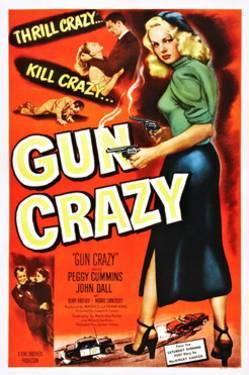
GUN CRAZY (1950) and an Ode to John Dall

Starring Peggy Cummins, John Dall, Berry Kroeger, Morris Carnovsky, Anabel Shaw, Harry Lewis, Nedrick Young, Rusty (Russ) Tamblyn. Directed by Joseph H. Lewis (1950/87 min).

AVAILABLE ON BLU-RAY FROM

Essay by D.M. ANDERSON

How many of you even know who the hell John Dall was?

In 1948's Rope, Dall seemed like the kind of guy who threw snowballs at strangers, taunted the handicapped and took fraternity hazings too far. That supremely punchable face, coupled with his character's cold-blooded arrogance and chilling disregard for humanity, made Brandon Shaw one of Hitchcock's greatest unheralded movie villains. Rope may have had Jimmy Stewart's name above the title, but Dall completely owned the film. It's a remarkably chilling performance.

In a perfect world, John Dall would have, at the very least, had a long, prolific career playing a variety of despicable douches...sort-of a Miguel Ferrer of his time. Instead, he died at age 50, having only appeared in eight movies, mostly in supporting roles (though he did do a lot of theater and television during his short career). Fortunately, Gun Crazy gave Dall the rare opportunity to show he was more than capable of carrying a movie without making the audience hate him.

His character is no hero, though. In true film-noir fashion, he's more-or-less a troubled sort whose life spirals out of control due to piss-poor choices for the sake of a woman.

John gets carsick pretty easily.
Bart Tare (Dall) has been a gun lover his entire life. As much as he loves shooting them - he's a hell of a good shot - Bart detests the thought of actually taking a life, stemming from a childhood incident when he shot a small animal. As a teen, his obsession leads him to actually steal a gun, resulting in four years at a reform school.

Following a stint in the military, Bart returns home and reunites with childhood friends, Dave and Clyde. He also meets his soulmate, Annie Laurie Starr (Peggy Cummins), a sharpshooter performing with a traveling carnival run by her sleazy & jealous boss, Packett (Barry Kroeger). Bart briefly joins the carnival as well, but after thwarting Packett's attempt to rape Annie, the two venture off and get married. Soon they are broke, and at Annie's urging, they embark on a cross-country crimewave, robbing stores, banks and eventually a company's payroll, which gets the FBI involved. Though Bart doesn't want to hurt anyone, Annie has no qualms about killing anyone who gets in their way.

"Annie, those stockings are for our faces."
It's a timeless story told with a lot of flare and Gun Crazy is a superior example of modestly-budgeted film-noir. By far, the best scene features the couple driving into a small town, robbing the bank and escaping capture, all in one lengthy, unbroken take, shot from the backseat of their getaway car. It's as technically impressive as Hitchcock's similar method method for shooting all of Rope.

But even the most stylish film-noir is nothing without its morally questionable characters, and Dall is especially effective. Bart's no saint - nor the brightest crayon in the box - but Dall instills the character with an increasing sense of remorse over the couple's escalating actions, making it difficult not to feel sorry for this poor rube, doomed from the moment he lays eyes on Annie. Sure, he ultimately brings all this misery on himself, but Dall's performance assures us Bart was never a truly bad man...just a conflicted one.

AVAILABLE ON BLU-RAY FROM
Alas, Gun Crazy was John Dall's last film in a leading role. As good as he was, either no one else would give him another shot or he simply preferred the stage. Or hell, maybe he was as face-punchingly insufferable to work with as Brandon Shaw at a dinner party. Whatever the case, Gun Crazy is a fast-moving, exciting and suspenseful classic that plays just as well today as it did 70 years ago, and a fine showcase one of Hollywood's most criminally underused actors.

EXTRA KIBBLES
FILM-NOIR: BRINGING DARKNESS TO LIGHT - An outstanding 70 minute documentary from 2006, featuring commentary by historians authors, screenwriters and filmmakers.
AUDIO COMMENTARY - By Author Glenn Erickson

KITTY CONSENSUS:
MEE-OW! LIKE TAUNTING A MOUSE TO DEATH

April 29, 2018

ONCE UPON A TIME (2017) and the Monotony of Monet

Starring Liu Yifei, Yang Yang, Luo Jin, Yan Yikuan, Li Chun, Gu Kuan, Peng Zisu. Directed by Zheo Xiaoding & Anthony LaMolinara. (2017/109 min).

AVAILABLE ON BLU-RAY FROM

Review by Tiger Longtail😼

Every now and then, my wife and I get the urge to introduce a bit of culture into our dreary lives. So when the Portland Art Museum announced an exhibit featuring the works of Claude Monet, Francie suggested we take the kids downtown one weekend to indulge in a bit of art appreciation. I had no problem with it since this particular weekend was the museum's monthly free admission day. Art is always easier to appreciate when it doesn't cost anything but gas.

For you uncouth swine who don't share my pretension for enjoying fine art, Claude Monet was a French impressionist who's probably most renowned for painting pictures of flowers, ponds and waterlilies, occasionally punctuated by people picnicking around flowers and ponds with waterlilies. Most of Monet's work is light, colorful and certainly pretty to look at. But like AC/DC, most of Monet's paintings are pretty much variations of the same thing. Walking the museum halls with my wife and kids, getting our money's worth (hey, gas ain't cheap!) by stopping to gaze at every single painting, I was thoroughly bored after about 15 minutes.

Claude Monet...the Impressionist Movement's AC/DC.
Watching China's fantasy epic, Once Upon a Time, is kind-of like slogging through that Monet exhibit. It's colorful, absolutely gorgeous and features some otherworldly imagery that - while obviously CGI - practically jumps off the screen. And for the first 10 minutes or so, the film is visually enthralling, even though we're never once convinced these actors are sharing the same space as their surroundings.

Unfortunately, it's all to serve a relentlessly talky, convoluted story that feels like we're joining it halfway through. In a nutshell, Once Upon a Time is sort of a fairy tale, mostly about a September courtship between two shape-shifting immortals, Bai Qian and Ye Hua, who also happen to be royalty and have been betrothed to each other (even though he's 50,000 years younger). There are also a slew of flashbacks of Ye Hua's previous marriage (to a mortal who saved his life), as well as a vengeful sorceress, a jealous princess and a guy in frozen stasis named Mo Yuan, all stirred into a plot that, despite ample exposition by various bland characters, is murky and uninvolving. What we have left are the visuals and sporadic bursts of action, which of course includes gravity-defying swordplay and movement so CGI-heavy that it all ceases to be logistically convincing.

Ye Hua visits Supercuts.
Worse yet, now imagine Monet taking one of his most famous paintings, like In the Garden, and handing it over to French comic artist Peyo, who adds Papa Smurf to the picture. Once Upon a Time does something similar, giving Bai Qian a comic relief sidekick who resembles a walking cabbage and looks like he was designed by someone from a completely different animation studio.

Despite being technically ambitious, I'm not sure what audience Once Upon a Time is aiming for. The narrative is too confusing for kids, the action too generic for thrill-seekers and the characters too bland to create any dramatic interest. What we're left with is similar to a gallery of Monet paintings: It is unarguably beautiful, but scene after scene of dazzling imagery, no matter how creatively rendered, becomes monotonous after awhile.

EXTRA KIBBLES
None
KITTY CONSENSUS:
MEH...PRETTY IS NOT ENOUGH

Rest in Peace, Michael Anderson

April 28, 2018

TIME AFTER TIME (1979): Leading Man McDowell?

Starring Malcolm McDowell, David Warner, Mary Steenburgen, Charles Cioffi, Kent Williams, Patti D'Arbanville, Joseph Maher. Directed by Nicholas Meyer. (1979/112 min).

AVAILABLE ON BLU-RAY FROM

Review by Mr. Paws🙀

For Malcolm McDowell, the shadow of A Clockwork Orange has always loomed large (or DeLarge...yuk, yuk, yuk). On this side of the Atlantic, anyway, that movie pretty-much cemented him as a bad guy the same way William Shatner will always be a starship captain. That being said, there was sort-of a poetic symmetry when McDowell was tapped to kill Captain Kirk in Star Trek Generations.

In the 70s, McDowell was mostly known to American audiences for his uninhibited performance as Alex DeLarge in A Clockwork Orange and, to a lesser extent, the horse-fisting, sister-banging titular lunatic in Caligula. So 1979's Time After Time was a bit of a revelation. Here was McDowell, not only the hero, but meek, refined, almost childlike in his naivety and - shock of shocks - a completely charming leading man. It's a wonderful performance that showed he could play a fish-out-of-water just as convincingly as a sadistic thug.

"It's colonoscopy time, ol' chap."
McDowell plays a fictionalized version of H.G. Wells, who in 1893 builds a time machine and shows it off to a few colleagues during a dinner party. One of them, John Leslie Stevenson (David Warner), also happens to be the notorious Jack the Ripper, who just claimed his latest victim prior to arriving. When the police show up soon afterwards, Stevenson avoids capture by using the machine to escape into the future. When the machine returns, Wells uses the same coordinates and follows him to modern day San Francisco with the hopes of bringing Stevenson back to answer for his crimes. Stevenson, however, feels right at home in the future, which is a more violent world than the utopia Wells had always envisioned. He has no intent of returning and soon continues his murderous ways.

Nothing on TV.
Time After Time is also noteworthy for being the directorial debut of Nicholas Meyer, who'd later be tapped to save the Star Trek franchise from itself...twice. Here, he directs his own script with workmanlike skill. There isn't a lot of flash, but it's certainly a lot of fun. Similar to what he'd do with Star Trek II, he puts greater emphasis on character relationships and an engaging narrative than wowing us with visual flash. The detective story elements, contemporary social commentary and charming romance between Wells and Amy (Mary Steenburgen) more than make up for the silly special effects (which were quaint even in 1979).

Afterwards, Malcolm McDowell mostly went back to playing weirdos and bad guys (including a lot of low budget horror films), so maybe that remains his comfort zone. Still, it's nice to recall that he was equally adept - however briefly - as a leading man. Time After Time may not itself be timeless (though it recently inspired a short-lived TV series), but remains an engaging film, largely due to a guy who once committed movie murder with a giant phallus.

EXTRA KIBBLES
AUDIO COMMENTARY - By Nicholas Meyer and Malcolm McDowell
TRAILER
KITTY CONSENSUS:
PURR-R-R...LIKE A GOOD SCRATCH BEHIND THE EARS