September 3, 2024

MAKING APES: The Story Behind The Make-Up


MAKING APES: THE ARTISTS WHO CHANGED FILM (Blu-ray)
2019 / 87 min
Available at www.MovieZyng.com
Review by Princess Pepper😺

I first saw the original Planet of the Apes on TV when I was a kid, totally amazed at how realistic all these talking primates looked. Too young at the time to appreciate how groundbreaking those make-up effects were, I simply accepted them as characters, not made-up actors. 

Over five decades later, the illusion remains unbroken. John Chambers and Tom Burman’s creations are as convincing today as they were in 1968. Not even the great Rick Baker could improve upon them for Tim Burton’s 2001 remake, and nobody involved with the reboot franchise even bothered to try (choosing the CGI route instead).


1998’s Behind the Planet of the Apes remains the definitive documentary on the original film series, as well as its cinematic and cultural impact. Making Apes covers some of the same bases in less detail, while also including the more recent films. But as the title suggests, the primary focus of this one is the make-up effects. More specifically, the guys who created them.


PetSmart's September Employee of the Month.
The film is just as much a biography of Chambers and Burman’s careers - before, during & after Apes - as a behind-the-scenes look at their handiwork. Since Chambers passed away in 2001, much of their history is recalled by Burman (who also co-wrote & co-produced). He candidly discusses the their roles in the production of the original Planet of the Apes in considerable detail, as well as his sometimes volatile relationship with Chambers (who apparently wasn’t always the easiest guy to get along with). 

The film also features dozens of interviews with historians, filmmakers, surviving colleagues & actors involved in the series, as well as a plethora of testimonials from modern-era make-up artists who cite Chambers & Burman’s work as their biggest inspiration. Interviewees include Rick Baker, Joe Dante, John Landis, Guillermo del Toro, Howard Berger, Greg Nicotero, Richard Donner and Leonard Maltin.


For the most part, Making Apes is pretty interesting, but it features less footage highlighting the creative process and application than one might expect (though there are plenty of stills). What matters is we still walk away with renewed appreciation for what these artists were able to accomplish at the time, paving the way for everyone who followed.

THE POOP SCOOP: Creepy Kibbles For The Spooky Season

🙀PARAMOUNT SCARES VOL. 2 arrives on 4K Ultra HD October 1 from Paramount.
Everyone loves a sequel!  PARAMOUNT SCARES is back with another limited-edition collection of terrifying films, all available for the first time in 4K Ultra HD.  PARAMOUNT SCARES VOL. 2 arrives October 1, 2024 from Paramount Home Entertainment. This collectible box set includes four killer films that offer an exciting mix of all that the horror genre has to offer.  From a knife-wielding maniac in FRIDAY THE 13TH PART II, to the twisted thrills of ORPHAN: FIRST KILL, the terrifying zombie hordes of WORLD WAR Z, and the psychological terror of BREAKDOWN, this must-own collection delivers loads of chills and thrills. Each film in the 8-disc collection has been newly remastered and is presented on both 4K Ultra HD Disc and on Blu-ray in an individual case and special sleeve exclusive to the set, all housed in a premium box with original artwork.  PARAMOUNT SCARES VOL. 2 also includes more than 2.5 hours of bonus content, the unrated version of WORLD WAR Z, access to a Digital copy of each film, and exclusive collectible items. 


🙀LONGLEGS Coming to 4K, Blu-ray & DVD September 24 from Decal Releasing.
LONGLEGS, the surprise sleeper hit, is coming to 4K Ultra HD, Blu-ray and DVD on September 24 from Neon & Decal Releasing. Hailed as the "scariest film of the year," LONGLEGS was written and directed by Perkins and stars Maika Monroe, Blair Underwood, Alicia Witt, and Nicolas Cage. To date, Longlegs has grossed an impressive $71 million at the U.S. box office, and over $100 million globally. Dave Caplan produced and financed Longlegs through his C2 Motion Picture Group banner. Producers include Nicolas Cage along with his production company Saturn Films, Dan Kagan, Brian Kavanaugh-Jones, and Chris Ferguson. Synopsis: In pursuit of a serial killer, an FBI agent uncovers a series of occult clues that she must solve to end his terrifying killing spree. 


🙀MAXXXINE arrives October 8 on 4K UHD, Blu-ray, DVD, and Digital from Lionsgate.
In 1980s Hollywood, adult film star and aspiring actress Maxine Minx finally gets her big break. But as a mysterious killer stalks the starlets of Hollywood, a trail of blood threatens to reveal her sinister past.The murderous finale of Ti West’s X trilogy (X, Pearl) also features a star-studded ensemble including Elizabeth Debicki, Moses Sumney, Michelle Monaghan, Bobby Cannavale, Halsey, Lily Collins, with Giancarlo Esposito and Kevin Bacon. The third and final installment of Ti West’s X trilogy finally comes home when MAXXXINE arrives October 8 on 4K UHD, Blu-ray, DVD, and Digital from Lionsgate. With the previous titles in the trilogy receiving critical and audience acclaim, star Mia Goth shares that “it’s the biggest story of the three with the highest stakes” and Maxine is “just a force to be reckoned with.”


🙀DARK NIGHT OF THE SCARECROW 1 & 2: ULTIMATE COLLECTOR'S EDITION Double Feature on 4K & Blu-ray September 10 from VCI Entertainment.
On September 10th, VCI Entertainment presents Dark Night of the Scarecrow, and its 40-years-in-the-making sequel, Dark Night of the Scarecrow 2, bundled together in a Dark Night of the Scarecrows 1 & 2: Ultimate Collector’s Edition on 4K UHD and Blu-ray, packed with special features. When it made its premiere the week of Halloween in 1981, Dark Night of the Scarecrow was one of the highest rated TV movies of all time. Forty years in the making, Dark Night of the Scarecrow 2 returns to the small town where the events of the first film took place. The special features for both the 4K UHD and Blu-ray editions include a new 2023 Dark Night of the Scarecrows Triple Fan commentary track, hosted by Heath Holland (Cereal at Midnight podcaster) and featuring Robert Kelly, a noted film historian, and super-fan Amanda Reyes, an expert on TV movies, author, and podcaster; the original Dark Night of the Scarecrow commentary track with writer J.D. Feigelson and director Frank DeFelitta; a new 2023 Dark Night of the Scarecrow commentary by J.D. Feigelson; “Bubba Didn’t Do It: 30 Years of the Scarecrow” by Daniel Griffith; Dark Night of the Scarecrows cast reunion Q&A recorded at the 2011 Frightfest Film Festival; 1981 CBS World Premiere broadcast Promo; 1985 CBS Network re-broadcast promo; and a photo gallery.

September 2, 2024

EARTHQUAKE (in Sensurround): The Last Great Gimmick


EARTHQUAKE (1974)
Starring Charlton Heston, Ava Gardner, George Kennedy, Lorne Greene, Geneiéve Bujold, Richard Roundtree, Marjoe Gortner, Victoria Principal, Barry Sullivan, Lloyd Nolan, Kip Niven, Monica Lewis. Directed by Mark Robson. (123 min)

ESSAY BY D.M. ANDERSON💀

Earthquake turns 50 this year, but it’s an anniversary that’s unlikely to be celebrated with any fanfare. 

First, it’s a disaster movie, a genre that never garnered all that much respect, especially during its 1970s heyday. A few classics like Airport, The Poseidon Adventure and The Towering Inferno managed to earn critical accolades, but even the most positive reviews were often tempered with snarky observations of melodramatic subplots, stock characters and ridiculously huge casts (a majority of whom probably signed on for the money). 


Conversely, Earthquake was more-or-less critically savaged at the time of release. With the exception of the special effects (which won an Oscar), nearly every aspect of the movie was routinely dismissed as a cynical, poorly conceived attempt to capitalize on the success of previous disaster films. The addition of “Sensurround” tended to exacerbate the general consensus that this was nothing more than a “gimmick movie” (more on that later). 


Second, the reign of the disaster movie as mainstream cinema’s most popular pastime was fairly short. With The Towering Inferno, Earthquake and Airport 1975 all released within months of each other, 1974 was the peak of the genre’s popularity. Afterwards, there were a slew of cheap, laughably bad knock-offs, and ironically, some of the worst ones came from the same guy who was once responsible for the best ones (Irwin Allen). 


Soon after, a little movie called Airplane! came along in 1980 to ruthlessly - and brilliantly - parody every trope and cliche moviegoers associated with the genre, making it difficult to revisit most of these films with a straight face (though I can attest that 1978’s The Swarm and The Concorde: Airport ‘79 were funny enough on their own, albeit unintentionally). Airplane! may not have killed the genre, but it arguably sealed the coffin for a few decades. Disaster’s demise was as swift and merciless as the death of hair metal in the 90s.


"I swear, it was like this when I got here."
Still, Earthquake does deserve a certain amount of retrospective appreciation for its 50th anniversary, even if it only comes from yours truly. The film was a blockbuster and the second highest grosser of the year (right behind The Towering Inferno). That’s not to suggest any movie’s box-office success is an indication of its quality. After all, the entire Transformers franchise is a steaming pile of robot shit, no matter how many 11-year-old boys handed over their allowance to gawk at the screen in slack-jawed wonder.

Admittedly, many of the criticisms aimed at Earthquake over the years are indeed valid, but simply went unnoticed in 1974 by my 11-year-old self, handing over my allowance to gawk at the screen in slack-jawed wonder. So maybe much of my current appreciation for the film is purely nostalgic. Not only was disaster my favorite genre (and still is), this was my first “gimmick movie,” that gimmick being the sinus-clearing wonder of Sensurround.


I had the misfortune of being born too late to experience the golden age of movie gimmicks, employed by studios and enterprising indie moguls to tear people away from their televisions. So I missed out on Cinerama, 3-D, barf bags and fright insurance, to say nothing of producer William Castle’s crazy collection of tacky tricks (such as creating ‘Percepto’ for The Tingler, which involved attaching buzzers to theater seats). 


Sensurround was a brand new, highly-publicized movie-enhancing technology. It was developed by Universal Studios for Earthquake and consisted of massive speakers amplified to emit an extremely low-frequency rumble. These speakers were installed in the front & back of theater auditoriums, and during the film’s two major quake sequences, they were powerful enough to cause every seat to vibrate. 


Not only was this expensive, it required most theaters to remove several rows of seats to accommodate the size of the speakers. Additionally, there were incidents in which Sensurround caused plaster to fall from the ceilings of a few theaters where the film played. It also created a problem for many multiplexes because Earthquake’s rumbling could be heard in adjoining auditoriums. Unlike the comparative simplicity of 3-D, this particular endeavor carried a significant amount of financial risk.

But it paid off. As gimmicks go, Sensurround was a pretty damn good one for the time and truly turned Earthquake into “An Event” (just as the tagine touted on the original one-sheet and in newspaper ads). I certainly treated it as such when, after months of pestering my parents, they finally agreed to drop a friend and I off at the Eastgate Tri-Cinema. Entering the auditorium itself, I was awestruck by the sheer size of these speakers, as big as my dad’s VW Beetle and standing taller than a Great Dane. The were almost intimidating, but I still thought sitting right in front of one might be cool. My friend, however, insisted we sit somewhere in the middle. Coward.


As for the movie itself, Earthquake assembles the usual all-star cast to wonder around and dig each other out of the rubble after a massive quake hits Los Angeles. Charlton Heston stars as Stewart Graff, a successful architect who designs skyscrapers for a company owned by his father-in-law, Sam Royce (Lorne Greene). He’s married to Royce’s angry, obnoxious, pill-popping daughter, Remy (Ava Gardner). Remy suspects Stewart is having an affair with young aspiring actress Denise (Geneiéve Bujold), which isn’t actually true until Remy’s vindictiveness drives him into her arms.


"Lady, I do everything in Sensurround, if you know what I mean."
Elsewhere, George Kennedy is on-hand to pretty-much play the same guy he does in the Airport movies (this time as a hard-nosed cop on suspension). Others along for the ride include Richard Roundtree as a motorcycle daredevil, Marjoe Gortner as a creepy, unhinged National Guardsman who becomes fixated on Rosa (Victoria Principal), and Walter Matthau as a dancing drunk (essentially a cameo, he’s billed as Walter Matuschanskayasky).

Ever since seeing Planet of the Apes, I was a big Charlton Heston fan. He was doing a lot of disaster movies at the time, and until I discovered Steve McQueen, Chuck was the coolest movie star in the world, so I thought he was great in Earthquake. Ava Gardner, on the other hand, looked and sounded like the scary old aunt in my family who reeked of cigarettes and Pond’s cold cream. Being 11 at the time, I had no idea she was once the most smoking hot femme fatale in film noir history. 


Of course, all these actors take a back seat to the true stars of the movie, the special effects team. There are two massive (and lengthy) quakes during the film, and Los Angeles ends up pretty well wasted. Skyscrapers crumble, bridges collapse, a dam bursts, houses topple or explode; victims fall to their deaths, get crushed, blown up, broiled, drowned or shot by Gortner (the film’s only real villain). 


The special effects are a (mostly) seamless combination of real sets, miniatures and incredible matte paintings by the legendary Albert Whitlock. Much of the destruction is pretty convincing even by modern standards, save for a few goofy scenes, such as when a cattle truck flies off of a crumbling bridge. Though the truck topples a hundred feet to the ground, none of the anti-gravity cows fall out. Another now-infamous scene shows passengers in a high-rise elevator falling to their deaths. When they hit the ground floor, an animated splotch of red paint is badly superimposed over the shot. The effect is unintentionally hilarious.
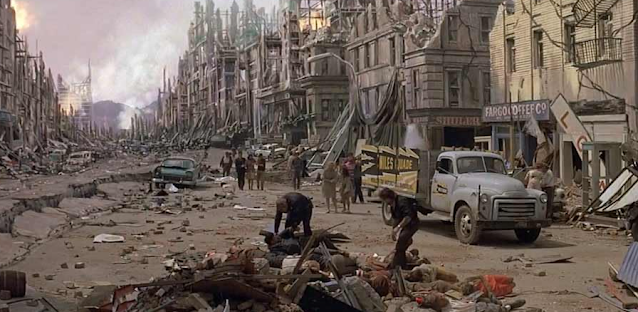

Sensurround certainly lowers property values..
Earthquake deserves additional kudos for being one of the few disaster movies with a fairly downbeat ending. A majority of the cast is dead by the time the credits roll (I won’t say who!), and the few who survive aren’t embracing each other, happy to be alive. They are understandably shellshocked, dazed and confused. Earthquake is also the only time you’ll ever hear Lorne Greene roar, “Take off your panty hose, dammit!” (imagine if he had yelled that on Bonanza).

I left the theater physically drained and sporting a headache, but it was allowance money well spent. Well spent twice, actually, because I went back a few weeks later (by myself this time) to watch it again. On Eastgate’s massive curved screen, compounded by bone-rattling Sensurround, Earthquake was as amazingly immersive as movies got at the time. 


But the novelty of Sensurround ended up being short-lived. Universal would use it for three more films (Midway, Rollercoaster and Battlestar Galactica), but it was only really effective in Earthquake, when the idea was still new. Since then, cinema technology has advanced to the point where nearly all action movies jar our fillings loose. 


Looking back at it 50 years later - having since revisited it numerous times without Sensurround - I wouldn’t call Earthquake a great film. Like the use of 3-D in Avatar, those Beetle-sized speakers made the whole thing seem bigger and better than it really was. Today, we’ve all undoubtedly experienced something similar to Sensurround whenever some passing motorist shares his love of rap music with everyone in a three block radius. But in 1974, we hadn’t seen or heard anything like it before. For those of us who were once blown away by Earthquake in theaters as children, it’s an anniversary worth remembering.

September 1, 2024

CRUEL JAWS: The Novelization...Really!


CRUEL JAWS (Novel)
By Brad Carter
2024 / 336 pp
Review by Mr. Bonnie, the Bookworm😺

What a cool idea…take some of cinema’s cheesiest, most craptastic low budget horror films and give ‘em the full novelization treatment. Then include covers that either resemble the original promotional artwork, or better yet, look like they could’ve been released back in the good ol’ days when such pulpy paperbacks were found at every Waldenbooks and supermarket rack in the country.

It’s the brainchild of Encyclopocalypse Publications, and I can’t believe I’ve just now learned about this Movie Tie-In Series. Growing up with paperback novelizations like this is what got me to start (voluntarily) reading in the first place. Encyclopocalypse is now partnering with Severin Films to produce a series of novels based on classic cult films released by the label over the years. First up is Cruel Jaws, inspired by one of the goofiest, most infamous Jaws ripoffs ever made. 


For those unaware, Cruel Jaws was notorious for its cut-rate production, copycat story (right down to copping some of Jaws’ dialogue) and lifting most of the shark footage from other movies…including Jaws itself. An Italian production (though shot in the U.S.), it was directed by prolific sleaze merchant Bruno Mattei, who never met a popular film he couldn’t redo faster and cheaper.


The novel, adapted by Brad Carter from the original screenplay, tells basically the same story and includes some of the same daffy dialogue, though it nicely fleshes out the film’s cardboard characters and expands the subplots. At the same time, Carter doesn’t forget he’s cranking out a pulpy piece of exploitation. The novel is loaded with gobs of nasty gore and explicit sex, which was ironically absent from the film (considering Mattei’s dubious reputation). 


Available in two editions.
Obviously, we ain’t talking The Old Man and the Sea here. The book will never be mistaken for great literature, nor is its author a master wordsmith. Still, Cruel Jaws is a fun read, with plenty of spectacular shark action that Mattei was simply unable to depict with the meager resources at his disposal. A guilty pleasure, to be sure, but a compulsive page turner.

The icing on the cake is the wonderful book design. Cruel Jaws is available in both mass market or trade editions, each with different covers. The trade version features the film’s original promotional art. But personally, I have a nostalgic soft spot for the mass market edition because it closely resembles the Jaws 2 novelization and recalls an era when novels like this were never intended as anything more than quick & dirty beach reads (which this book definitely is). 


And what movie tie-in would be complete without stills from the movie itself? This one includes 17 pages of black & white photos along and the film’s original poster art. The book also features a forward by Sharksploitation director Stephen Scarlata, who nicely sums up Cruel Jaws’ place in the pantheon of squalid shark cinema. 


We’ve all heard someone boast their literary snootiness with “the book was better than the movie.” But in this case, it’s inarguably true. While you may ashamed of yourself for enjoying it, Cruel Jaws is a bloody blast.